On December 8, 1888, a short notice appeared among the local items in Albany’s News and Advertiser:
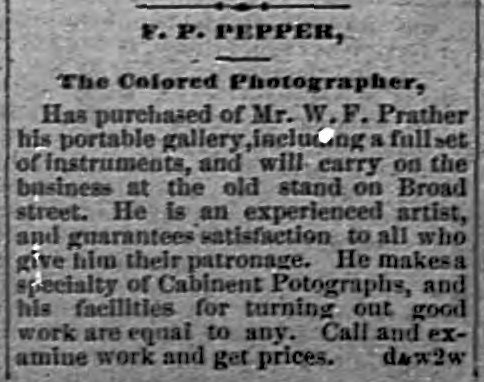
“F. P. Pepper, The Colored Photographer, Has purchased of Mr. W. F. Prather his portable gallery, including a full set of instruments, and will carry on the business at the old stand on Broad street.”
The notice said he was “an experienced artist” who “guarantees satisfaction to all who give him their patronage.” He made “a specialty of Cabinet Potographs,” it said, and “his facilities for turning out good work are equal to any.”
Pepper was new to Albany that year. In February the Atlanta Constitution called him “the first colored photographer who ever came to this place.” He had started out in a tent on Washington Street, with sample pictures on display. Four years earlier, the Americus Recorder had reported “a colored artist” with his tent pitched in Dawson.
Fremont P. Pepper was more than a photographer. He was also a teacher. An AME church history lists him as an early president of Payne Institute in Cuthbert. In 1889 Albany’s paper called him “a highly respected colored teacher” at the city’s Colored Academy.
The portable gallery suited the way he worked. For the next two decades he followed the business from town to town: Americus, Montezuma, Buena Vista, Vienna, Unadilla, Lilly and Pinehurst. In Vienna he set up in a tent across from the courthouse. In 1903, when another man went around Dooly County posing customers and claiming ties to him, Pepper answered in the local paper:
“He is connected with me in no way.”
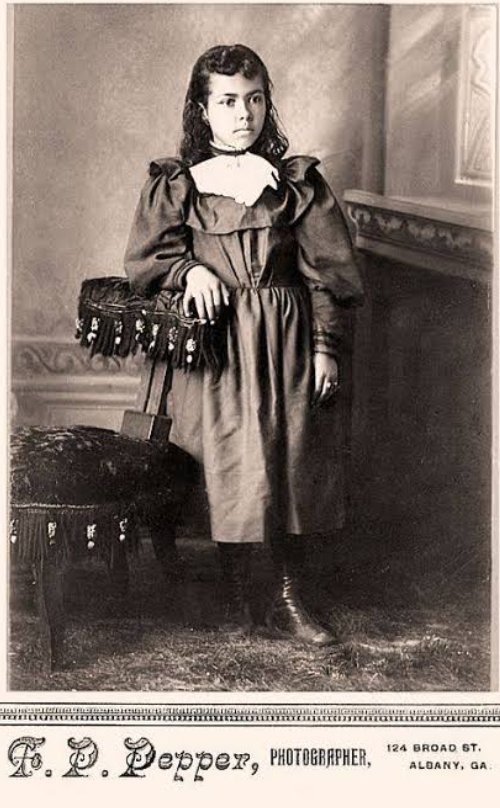
His surviving cabinet cards are stamped “F. P. Pepper, Photo Artist” or “F. P. Pepper, Photographer, 124 Broad St., Albany, Ga.” His customers were Black and white.
The 1910 census found him in Unadilla, still working as a photographer. After that the record goes quiet. Where and when he died is not known.
Background: E. Lee Eltzroth, “An African American Itinerant Photographer,” Georgia Photographers (2014), citing the Atlanta Constitution, Americus Recorder, Albany News and Advertiser, Vienna News and federal censuses.