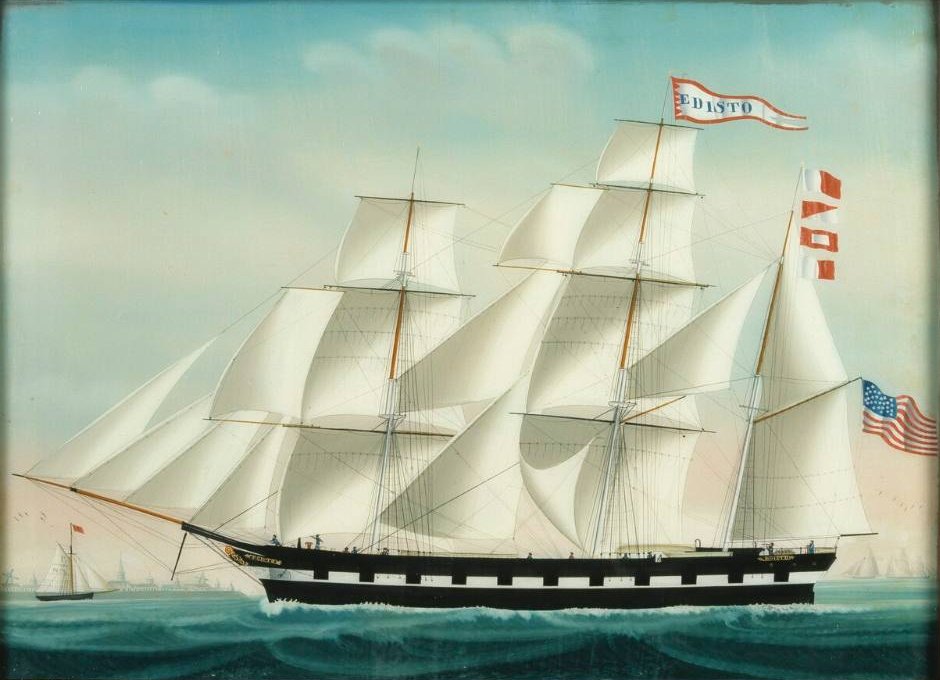
The editors
Editorial, column 1
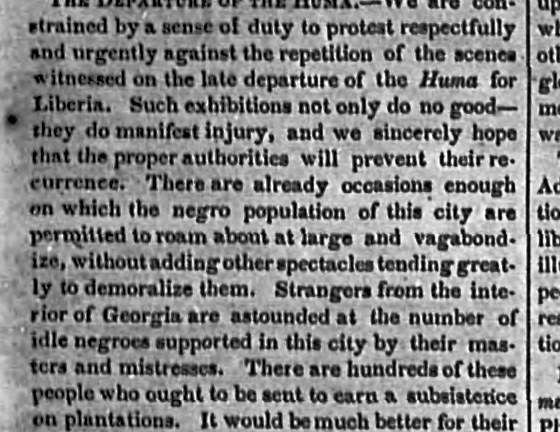
“There are hundreds of these people who ought to be sent to earn a subsistence on plantations.”
Black history and life as seen through Savannah’s newspapers, 1763–1965
177 years ago.
Black people going back to Africa
On Monday, May 14, 1849, the barque Huma left Savannah for Liberia with 181 emigrants: 77 from Savannah, 49 from Charleston, 29 from Augusta, 15 from Hamburg and 11 from the interior of Georgia. The morning began with prayers and speeches on the wharf. The American Colonization Society’s agent put the crowd at “not less than five thousand persons.”
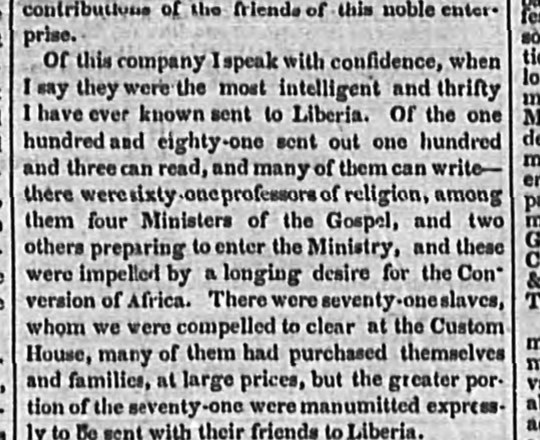
Among those leaving was the Rev. Isaac Roberts, for many years pastor of the “3d African Church” in Savannah, who gave a farewell address to his congregation. Of the 181, the agent reported, 103 could read. Seventy-one had been enslaved, and many of them had bought their own freedom and their families’.
Three days later, the Savannah Daily Republican printed three pieces about the departure on one page: the agent’s report, an editorial protesting “the repetition of the scenes witnessed,” and a letter signed “A Savannian” from a self-described slaveholder who asked City Council and the grand jury to make sure it never happened again.
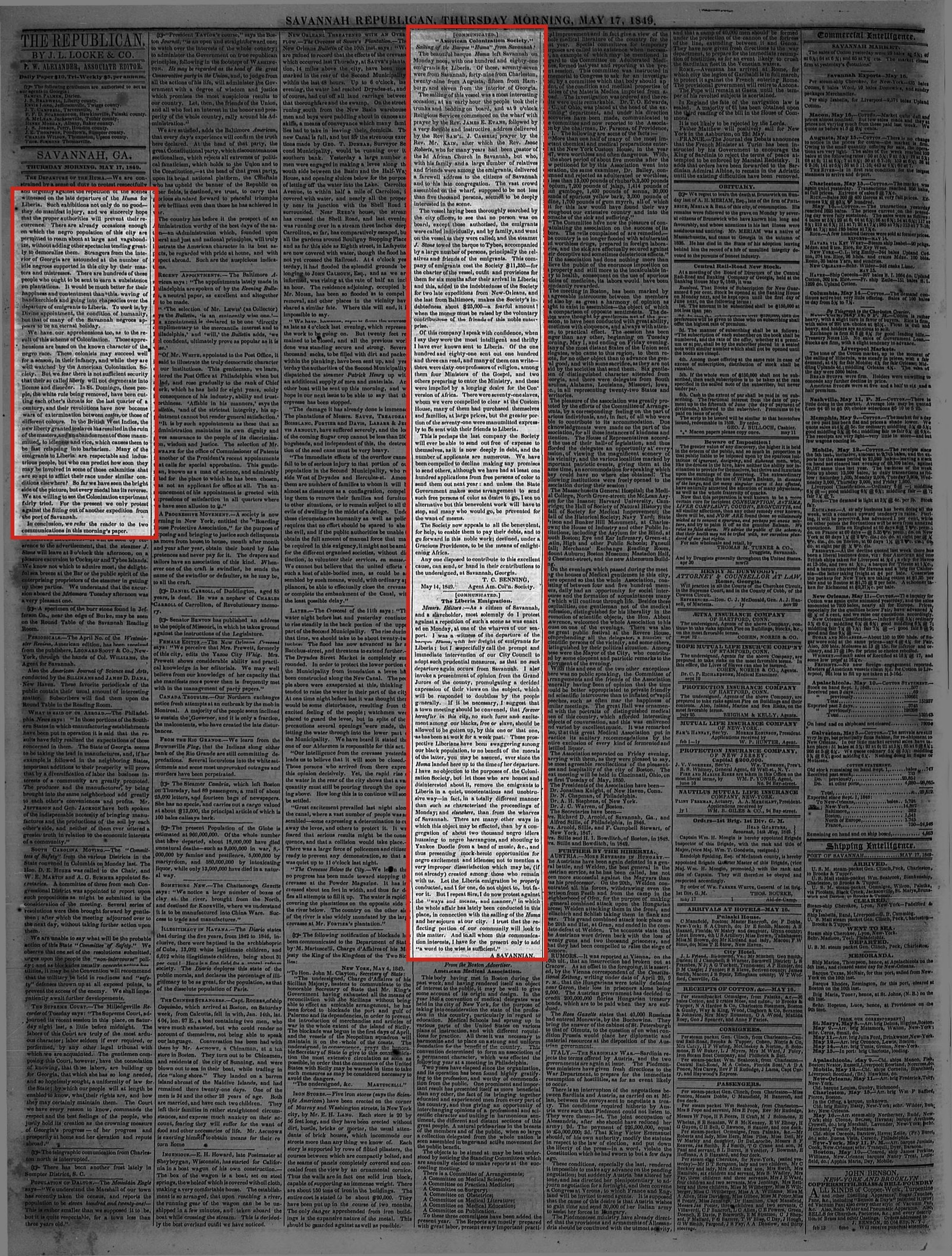
Every word, as printed, top to bottom. Scroll inside each column.
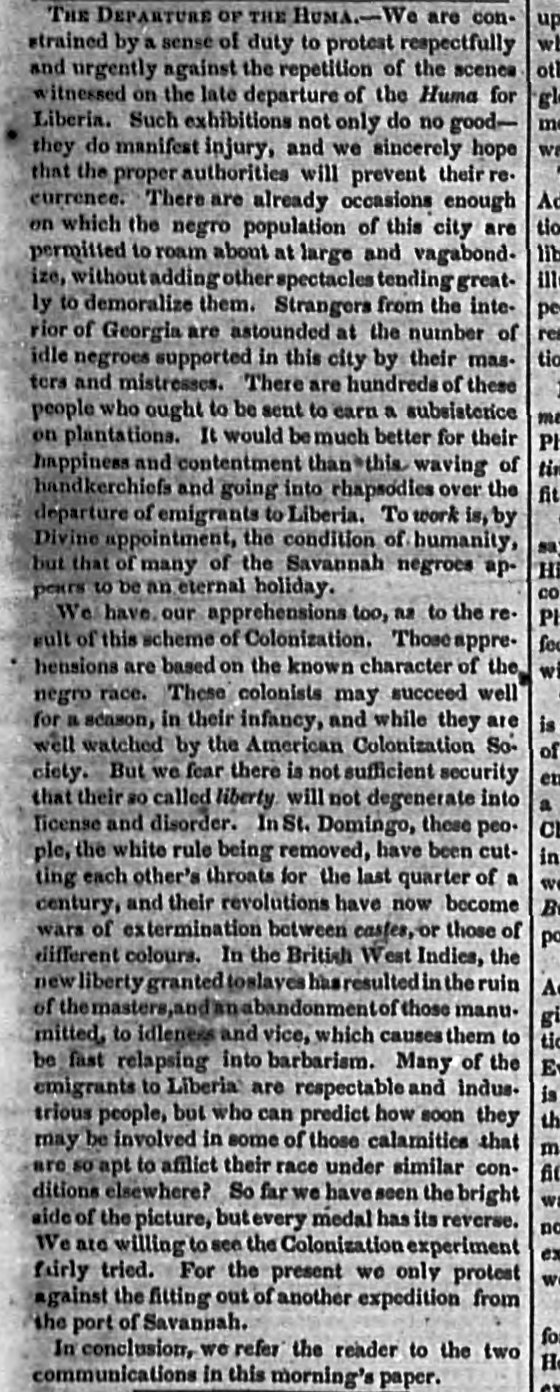

The editorial closed by telling readers to see “the two communications in this morning’s paper.”
“There are hundreds of these people who ought to be sent to earn a subsistence on plantations.”
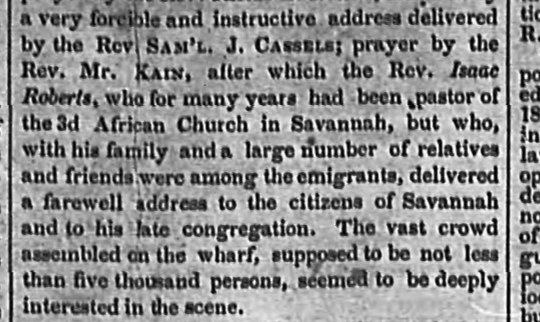
“The vast crowd assembled on the wharf, supposed to be not less than five thousand persons, seemed to be deeply interested in the scene.”
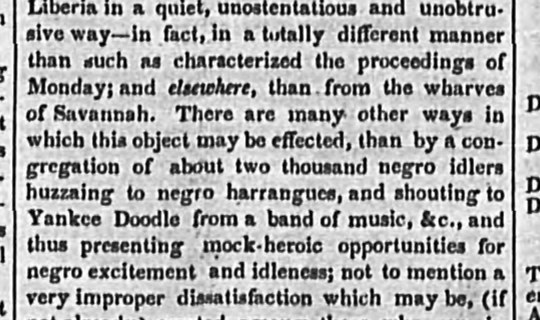
“…a congregation of about two thousand negro idlers huzzaing to negro harrangues, and shouting to Yankee Doodle from a band of music…”
Transcribed from the page and checked word by word. Original spelling, italics and language kept.
THE DEPARTURE OF THE HUMA.—We are constrained by a sense of duty to protest respectfully and urgently against the repetition of the scenes witnessed on the late departure of the Huma for Liberia. Such exhibitions not only do no good—they do manifest injury, and we sincerely hope that the proper authorities will prevent their recurrence. There are already occasions enough on which the negro population of this city are permitted to roam about at large and vagabondize, without adding other spectacles tending greatly to demoralize them. Strangers from the interior of Georgia are astounded at the number of idle negroes supported in this city by their masters and mistresses. There are hundreds of these people who ought to be sent to earn a subsistence on plantations. It would be much better for their happiness and contentment than this waving of handkerchiefs and going into rhapsodies over the departure of emigrants to Liberia. To work is, by Divine appointment, the condition of humanity, but that of many of the Savannah negroes appears to be an eternal holiday.
We have our apprehensions too, as to the result of this scheme of Colonization. Those apprehensions are based on the known character of the negro race. These colonists may succeed well for a season, in their infancy, and while they are well watched by the American Colonization Society. But we fear there is not sufficient security that their so called liberty will not degenerate into license and disorder. In St. Domingo, these people, the white rule being removed, have been cutting each other's throats for the last quarter of a century, and their revolutions have now become wars of extermination between castes, or those of different colours. In the British West Indies, the new liberty granted to slaves has resulted in the ruin of the masters, and an abandonment of those manumitted, to idleness and vice, which causes them to be fast relapsing into barbarism. Many of the emigrants to Liberia are respectable and industrious people, but who can predict how soon they may be involved in some of those calamities that are so apt to afflict their race under similar conditions elsewhere? So far we have seen the bright side of the picture, but every medal has its reverse. We are willing to see the Colonization experiment fairly tried. For the present we only protest against the fitting out of another expedition from the port of Savannah.
In conclusion, we refer the reader to the two communications in this morning's paper.
[COMMUNICATED.]
"American Colonization Society."
Sailing of the Barque "Huma" from Savannah!
The beautiful barque Huma left Savannah on Monday noon, with one hundred and eighty-one emigrants for Liberia. Of these, seventy-seven were from Savannah, forty-nine from Charleston, twenty-nine from Augusta, fifteen from Hamburg, and eleven from the interior of Georgia.
The sailing of this vessel was a most interesting occasion, at an early hour the people took their trunks and bedding on board, and at 9 o'clock Religious Services commenced on the wharf with prayer by the Rev. JAMES E. EVANS, followed by a very forcible and instructive address delivered by the Rev. SAM'L. J. CASSELS; prayer by the Rev. Mr. KAIN, after which the Rev. Isaac Roberts, who for many years had been pastor of the 3d African Church in Savannah, but who, with his family and a large number of relatives and friends were among the emigrants, delivered a farewell address to the citizens of Savannah and to his late congregation. The vast crowd assembled on the wharf, supposed to be not less than five thousand persons, seemed to be deeply interested in the scene.
The vessel having been thoroughly searched by the city officers, to see that no person was on board, except those authorised, the emigrants were called individually, and by family, and went on the vessel as they were called; and the steamer J. Stone towed the barque to Tybee, accompanied by a large number of persons, principally the relatives and friends of the emigrants. This company of emigrants cost the Society $11,350—for the charter of the vessel, outfit and provisions for them for six months after their arrival in Liberia; and this, added to the indebtedness of the Society for two late expeditions from New-Orleans, and the last from Baltimore, makes the Society's indebtedness about $25,000—a fearful amount! when the money must be raised by the voluntary contributions of the friends of this noble enterprise.
Of this company I speak with confidence, when I say they were the most intelligent and thrifty I have ever known sent to Liberia. Of the one hundred and eighty-one sent out one hundred and three can read, and many of them can write—there were sixty-one professors of religion, among them four Ministers of the Gospel, and two others preparing to enter the Ministry, and these were impelled by a longing desire for the Conversion of Africa. There were seventy-one slaves, whom we were compelled to clear at the Custom House, many of them had purchased themselves and families, at large prices, but the greater portion of the seventy-one were manumitted expressly to be sent with their friends to Liberia.
This is perhaps the last company the Society will ever be able to send out free of expense to themselves, as it is now deeply in debt, and the number of applicants are numerous. We have been compelled to decline making any promises to send others, although we have had at least one hundred applications from free persons of color to send them out next year: and unless the State Government makes some arrangement to send such free persons of color as desire to go, I see no alternative but this benevolent work will have to stop, and many who would go, be prevented for the want of means.
The Society now appeals to all the benevolent, for help, to enable them to pay their debts, and to go forward in this noble work; destined, under a Gracious Providence, to be the means of enlightening Africa.
Any one disposed to contribute to this excellent cause, can send, or hand in their contributions to the undersigned, at Savannah, Georgia.
T. C. BENNING,
May 14, 1849. Agent Am. Col'n. Society.
[COMMUNICATED.]
The Liberia Emigration.
Messrs. Editors:—As a citizen of Savannah, and a slaveholder, most solemnly do I protest against a repetition of such a scene as was enacted on Monday, at one of the wharves of our seaport. I was a witness of the departure of the barque Huma, with her freight of emigrants for Liberia; but I respectfully call the prompt and immediate intervention of our City Council to adopt such prudential measures, as that no such departure again occurs from Savannah. I also invoke a presentment of opinion from the Grand Jurors of the county, promulgating a decided expression of their views on the subject, which will be responded to doubtless by the people generally. If it be necessary, I suggest that a town meeting should be convened, that forever hereafter in this city, no such furor and excitement among our blacks, free or slave, should be allowed to be gotten up, by this one or that one, as has been at work for a week past. These prospective Liberians have been swaggering among our black population, to no benefit of the morals of the latter, you may be assured, ever since the Huma landed here up to the time of her departure. I have no objection to the purposes of the Colonization Society, but let those who are honest and disinterested about it, remove the emigrants to Liberia in a quiet, unostentatious and unobtrusive way—in fact, in a totally different manner than such as characterized the proceedings of Monday; and elsewhere, than from the wharves of Savannah. There are many other ways in which this object may be effected, than by a congregation of about two thousand negro idlers huzzaing to negro harrangues, and shouting to Yankee Doodle from a band of music, &c., and thus presenting mock-heroic opportunities for negro excitement and idleness; not to mention a very improper dissatisfaction which may be, (if not already) created among those who remain with us. Let the Liberia emigration be properly conducted, and I for one, do not object to, but favor it. But I repeat Sirs, I do now protest against the "ways and means, and manner," in which the whole affair has lately been conducted in this place, in connection with the sailing of the Huma and her sojourn at our city. I trust that the reflecting portion of our community will look to this matter. And to all whom this communication interests, I have for the present only to add "a word to the wise is sufficient."
A SAVANNIAN.
Walk Savannah’s waterfront on Hidden in Plain Sight: An Incomplete Freedom, a free self-guided tour.
Go to [MATCHING STOP] →Every name printed in these pieces, as printed. Tap a name to see every story where it appears.
“The Departure of the Huma”; “American Colonization Society. Sailing of the Barque ‘Huma’ from Savannah!”; “The Liberia Emigration.” Savannah Daily Republican (Savannah, GA), May 17, 1849, p. 2. Georgia Historic Newspapers, Digital Library of Georgia.
Black history and life as seen through Savannah’s newspapers, 1763–1965
{{yearsAgo}} {{stampText}}.
Black people going back to Africa
{{nowText}}
On Monday, May 14, 1849, the barque Huma left Savannah for Liberia with 181 emigrants: 77 from Savannah, 49 from Charleston, 29 from Augusta, 15 from Hamburg and 11 from the interior of Georgia. The morning began with prayers and speeches on the wharf. The American Colonization Society’s agent put the crowd at “not less than five thousand persons.”
Among those leaving was the Rev. Isaac Roberts, for many years pastor of the “3d African Church” in Savannah, who gave a farewell address to his congregation. Of the 181, the agent reported, 103 could read. Seventy-one had been enslaved, and many of them had bought their own freedom and their families’.
Three days later, the Savannah Daily Republican printed three pieces about the departure on one page: the agent’s report, an editorial protesting “the repetition of the scenes witnessed,” and a letter signed “A Savannian” from a self-described slaveholder who asked City Council and the grand jury to make sure it never happened again.
Every word, as printed, top to bottom. Scroll inside each column.
The editorial closed by telling readers to see “the two communications in this morning’s paper.”
“There are hundreds of these people who ought to be sent to earn a subsistence on plantations.”
“The vast crowd assembled on the wharf, supposed to be not less than five thousand persons, seemed to be deeply interested in the scene.”
“…a congregation of about two thousand negro idlers huzzaing to negro harrangues, and shouting to Yankee Doodle from a band of music…”
Transcribed from the page and checked word by word. Original spelling, italics and language kept.
THE DEPARTURE OF THE HUMA.—We are constrained by a sense of duty to protest respectfully and urgently against the repetition of the scenes witnessed on the late departure of the Huma for Liberia. Such exhibitions not only do no good—they do manifest injury, and we sincerely hope that the proper authorities will prevent their recurrence. There are already occasions enough on which the negro population of this city are permitted to roam about at large and vagabondize, without adding other spectacles tending greatly to demoralize them. Strangers from the interior of Georgia are astounded at the number of idle negroes supported in this city by their masters and mistresses. There are hundreds of these people who ought to be sent to earn a subsistence on plantations. It would be much better for their happiness and contentment than this waving of handkerchiefs and going into rhapsodies over the departure of emigrants to Liberia. To work is, by Divine appointment, the condition of humanity, but that of many of the Savannah negroes appears to be an eternal holiday.
We have our apprehensions too, as to the result of this scheme of Colonization. Those apprehensions are based on the known character of the negro race. These colonists may succeed well for a season, in their infancy, and while they are well watched by the American Colonization Society. But we fear there is not sufficient security that their so called liberty will not degenerate into license and disorder. In St. Domingo, these people, the white rule being removed, have been cutting each other's throats for the last quarter of a century, and their revolutions have now become wars of extermination between castes, or those of different colours. In the British West Indies, the new liberty granted to slaves has resulted in the ruin of the masters, and an abandonment of those manumitted, to idleness and vice, which causes them to be fast relapsing into barbarism. Many of the emigrants to Liberia are respectable and industrious people, but who can predict how soon they may be involved in some of those calamities that are so apt to afflict their race under similar conditions elsewhere? So far we have seen the bright side of the picture, but every medal has its reverse. We are willing to see the Colonization experiment fairly tried. For the present we only protest against the fitting out of another expedition from the port of Savannah.
In conclusion, we refer the reader to the two communications in this morning's paper.
[COMMUNICATED.]
"American Colonization Society."
Sailing of the Barque "Huma" from Savannah!
The beautiful barque Huma left Savannah on Monday noon, with one hundred and eighty-one emigrants for Liberia. Of these, seventy-seven were from Savannah, forty-nine from Charleston, twenty-nine from Augusta, fifteen from Hamburg, and eleven from the interior of Georgia.
The sailing of this vessel was a most interesting occasion, at an early hour the people took their trunks and bedding on board, and at 9 o'clock Religious Services commenced on the wharf with prayer by the Rev. JAMES E. EVANS, followed by a very forcible and instructive address delivered by the Rev. SAM'L. J. CASSELS; prayer by the Rev. Mr. KAIN, after which the Rev. Isaac Roberts, who for many years had been pastor of the 3d African Church in Savannah, but who, with his family and a large number of relatives and friends were among the emigrants, delivered a farewell address to the citizens of Savannah and to his late congregation. The vast crowd assembled on the wharf, supposed to be not less than five thousand persons, seemed to be deeply interested in the scene.
The vessel having been thoroughly searched by the city officers, to see that no person was on board, except those authorised, the emigrants were called individually, and by family, and went on the vessel as they were called; and the steamer J. Stone towed the barque to Tybee, accompanied by a large number of persons, principally the relatives and friends of the emigrants. This company of emigrants cost the Society $11,350—for the charter of the vessel, outfit and provisions for them for six months after their arrival in Liberia; and this, added to the indebtedness of the Society for two late expeditions from New-Orleans, and the last from Baltimore, makes the Society's indebtedness about $25,000—a fearful amount! when the money must be raised by the voluntary contributions of the friends of this noble enterprise.
Of this company I speak with confidence, when I say they were the most intelligent and thrifty I have ever known sent to Liberia. Of the one hundred and eighty-one sent out one hundred and three can read, and many of them can write—there were sixty-one professors of religion, among them four Ministers of the Gospel, and two others preparing to enter the Ministry, and these were impelled by a longing desire for the Conversion of Africa. There were seventy-one slaves, whom we were compelled to clear at the Custom House, many of them had purchased themselves and families, at large prices, but the greater portion of the seventy-one were manumitted expressly to be sent with their friends to Liberia.
This is perhaps the last company the Society will ever be able to send out free of expense to themselves, as it is now deeply in debt, and the number of applicants are numerous. We have been compelled to decline making any promises to send others, although we have had at least one hundred applications from free persons of color to send them out next year: and unless the State Government makes some arrangement to send such free persons of color as desire to go, I see no alternative but this benevolent work will have to stop, and many who would go, be prevented for the want of means.
The Society now appeals to all the benevolent, for help, to enable them to pay their debts, and to go forward in this noble work; destined, under a Gracious Providence, to be the means of enlightening Africa.
Any one disposed to contribute to this excellent cause, can send, or hand in their contributions to the undersigned, at Savannah, Georgia.
T. C. BENNING,
May 14, 1849. Agent Am. Col'n. Society.
[COMMUNICATED.]
The Liberia Emigration.
Messrs. Editors:—As a citizen of Savannah, and a slaveholder, most solemnly do I protest against a repetition of such a scene as was enacted on Monday, at one of the wharves of our seaport. I was a witness of the departure of the barque Huma, with her freight of emigrants for Liberia; but I respectfully call the prompt and immediate intervention of our City Council to adopt such prudential measures, as that no such departure again occurs from Savannah. I also invoke a presentment of opinion from the Grand Jurors of the county, promulgating a decided expression of their views on the subject, which will be responded to doubtless by the people generally. If it be necessary, I suggest that a town meeting should be convened, that forever hereafter in this city, no such furor and excitement among our blacks, free or slave, should be allowed to be gotten up, by this one or that one, as has been at work for a week past. These prospective Liberians have been swaggering among our black population, to no benefit of the morals of the latter, you may be assured, ever since the Huma landed here up to the time of her departure. I have no objection to the purposes of the Colonization Society, but let those who are honest and disinterested about it, remove the emigrants to Liberia in a quiet, unostentatious and unobtrusive way—in fact, in a totally different manner than such as characterized the proceedings of Monday; and elsewhere, than from the wharves of Savannah. There are many other ways in which this object may be effected, than by a congregation of about two thousand negro idlers huzzaing to negro harrangues, and shouting to Yankee Doodle from a band of music, &c., and thus presenting mock-heroic opportunities for negro excitement and idleness; not to mention a very improper dissatisfaction which may be, (if not already) created among those who remain with us. Let the Liberia emigration be properly conducted, and I for one, do not object to, but favor it. But I repeat Sirs, I do now protest against the "ways and means, and manner," in which the whole affair has lately been conducted in this place, in connection with the sailing of the Huma and her sojourn at our city. I trust that the reflecting portion of our community will look to this matter. And to all whom this communication interests, I have for the present only to add "a word to the wise is sufficient."
A SAVANNIAN.
Walk Savannah’s waterfront on Hidden in Plain Sight: An Incomplete Freedom, a free self-guided tour.
Go to [MATCHING STOP] →Every name printed in these pieces, as printed. Tap a name to see every story where it appears.
“The Departure of the Huma”; “American Colonization Society. Sailing of the Barque ‘Huma’ from Savannah!”; “The Liberia Emigration.” Savannah Daily Republican (Savannah, GA), May 17, 1849, p. 2. Georgia Historic Newspapers, Digital Library of Georgia.