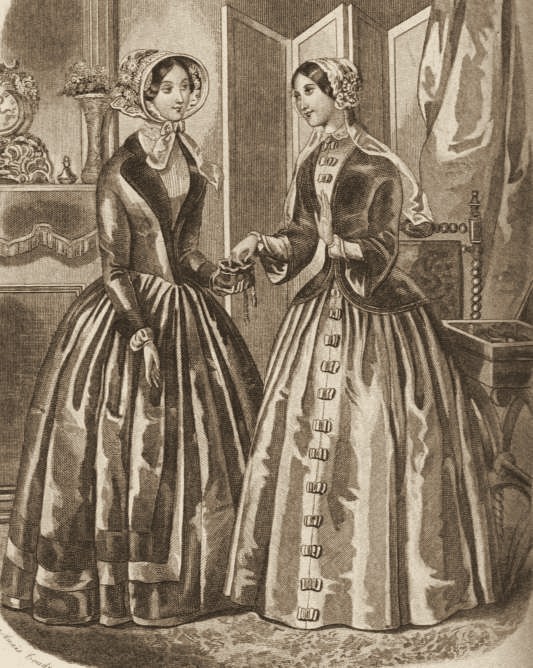
It started with a cigar
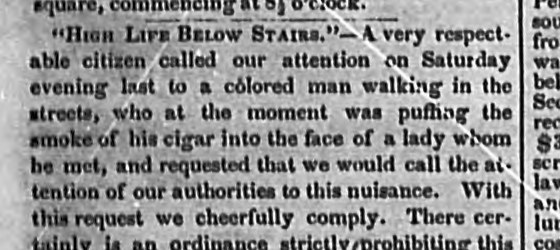
“…puffing the smoke of his cigar into the face of a lady whom he met…”
Black history and life as seen through Savannah’s newspapers, 1763–1965
177 years ago.
Black people’s cigars and clothes, and a call to sell them to the plantations
On a Saturday evening in early June 1849, a “very respectable citizen” saw a Black man walking in the street, puffing cigar smoke “into the face of a lady whom he met.” He took his complaint to the Savannah Daily Republican. On June 6 the editor answered with a column-long editorial headlined “High Life Below Stairs.”
It began with the city ordinance that banned Black people from smoking in the streets, which, he admitted, had not been enforced “for some time past.” Then it widened: hired-out workers who walked home to their owners and were protected, the “taste for dress,” turbans giving way to bonnets, tunics and sacks, and young girls’ pantalettes “edged with lace.”
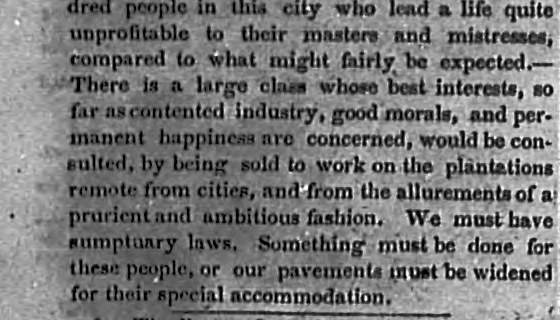
Near the end, he counted “at least five hundred people in this city” he called unprofitable to their owners, and said “a large class” would be better off “sold to work on the plantations remote from cities.” Part of the blame, he said, belonged to “Liberia colonizing and speech making,” three weeks after thousands gathered on the wharf to see the Huma sail.
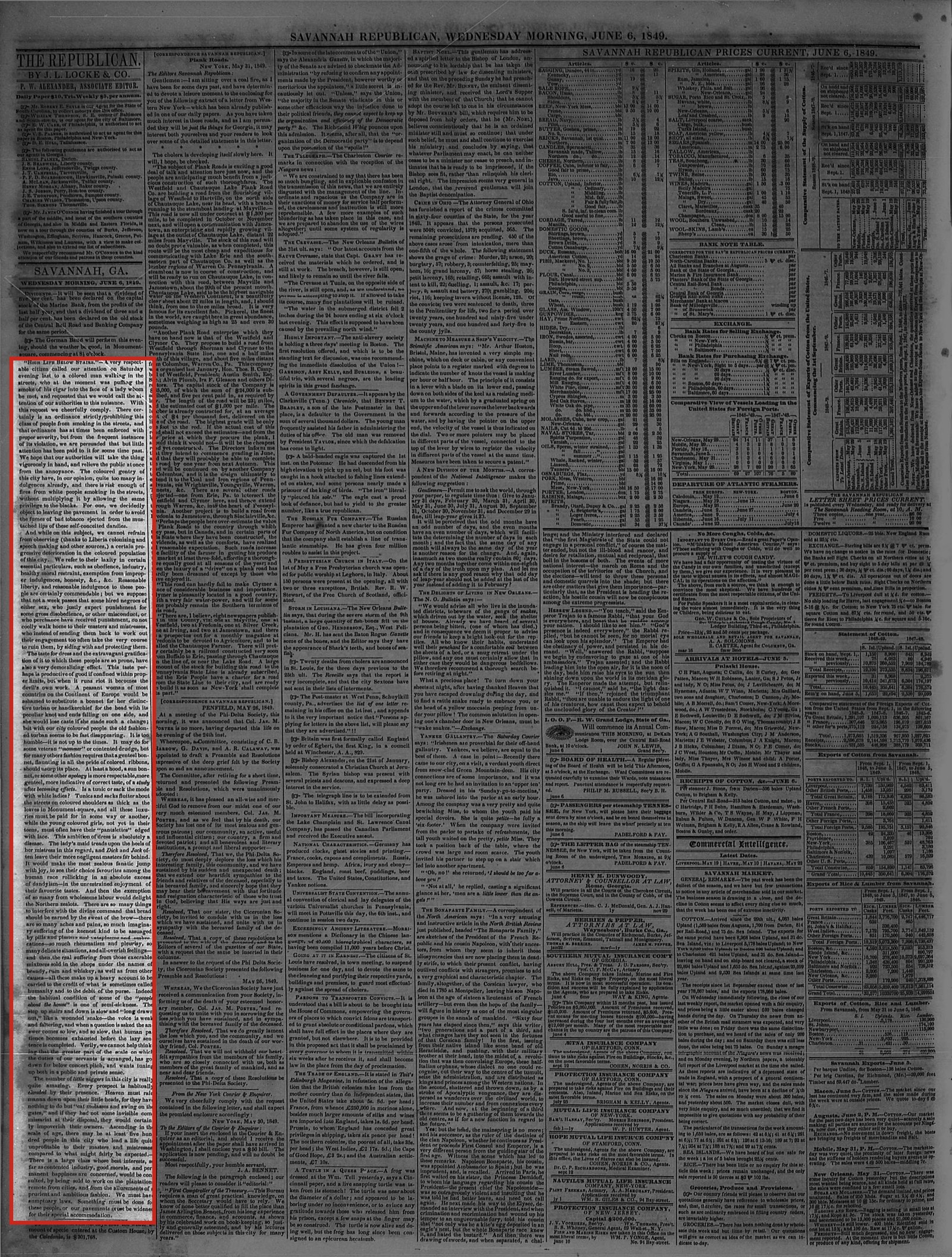
Every word, as printed, top to bottom. Scroll inside the column.

The clippings below are cut from the same column, top to bottom.
“…puffing the smoke of his cigar into the face of a lady whom he met…”
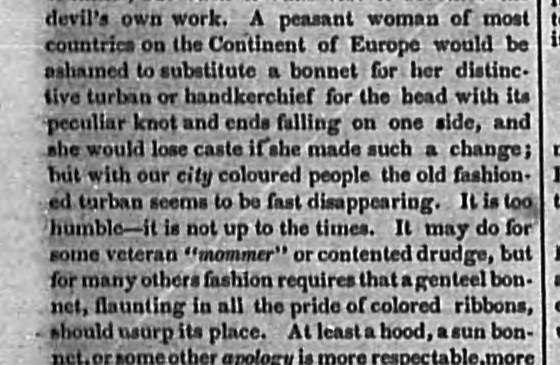
“…with our city coloured people the old fashioned turban seems to be fast disappearing.”
“…would be consulted, by being sold to work on the plantations remote from cities.”
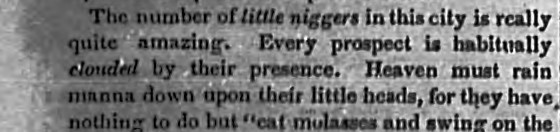
Transcribed from the page and checked word by word. Original spelling and italics kept. One racial slur is masked here; it appears unaltered in the scan above.
"HIGH LIFE BELOW STAIRS."—A very respectable citizen called our attention on Saturday evening last to a colored man walking in the streets, who at the moment was puffing the smoke of his cigar into the face of a lady whom he met, and requested that we would call the attention of our authorities to this nuisance. With this request we cheerfully comply. There certainly is an ordinance strictly prohibiting this class of people from smoking in the streets, and that ordinance has at times been enforced with proper severity, but from the frequent instances of its violation, we are persuaded that but little attention has been paid to it for some time past. We hope that our authorities will take the thing vigorously in hand, and relieve the public at once from the annoyance. The coloured gentry of this city have, in our opinion, quite too many indulgences already, and there is risk enough of fires from white people smoking in the streets, without multiplying it by allowing the same privilege to the blacks. For one, we decidedly object to leaving the pavement in order to avoid the fumes of bad tobacco ejected from the mustached lips of these self-conceited dandies.
And while on this subject, we cannot refrain from observing (thanks to Liberia colonizing and speech making and other sources,) a certain progressive deterioration in the coloured population of this city. We refer to their laxity in certain essential particulars, such as obedience, industry, healthy moral restraint, exemption from improper indulgences, honesty, &c., &c. Reasonable liberty, and reasonable indulgence to these people are certainly commendable; but we suppose that not a week passes that some hired negroes of either sex, who justly expect punishment for some gross disobedience, or other misconduct, or who perchance have received punishment, do not coolly walk home to their masters and mistresses, who instead of sending them back to work out their engagement too often take the very course to ruin them, by siding with and protecting them.
The taste for dress and the extravagant gratification of it to which these people are so prone, have also a very demoralizing effect. This taste perhaps is productive of good if confined within proper limits, but when it runs riot it becomes the devil's own work. A peasant woman of most countries on the Continent of Europe would be ashamed to substitute a bonnet for her distinctive turban or handkerchief for the head with its peculiar knot and ends falling on one side, and she would lose caste if she made such a change; but with our city coloured people the old fashioned turban seems to be fast disappearing. It is too humble—it is not up to the times. It may do for some veteran "mommer" or contented drudge, but for many others fashion requires that a genteel bonnet, flaunting in all the pride of colored ribbons, should usurp its place. At least a hood, a sun bonnet, or some other apology is more respectable, more genteel, more indicative of correct taste, of a study after becoming effects. Is a tunic or sack the mode with white ladies? Tunics and sacks flutter about the streets on coloured shoulders as thick as the leaves in Monument-square, and all these luxuries must be paid for in some way or another, while the young coloured girls, not yet in their teens, must often have their "pantalettes" edged with lace. This ambition of dress is absolutely a disease. The lady's maid treads upon the heels of her mistress in this regard, and Dick and Jack often leave their more negligent masters far behind. It would make the most zealous fanatic jump with joy, to see their choice favourites among the human race rollicking in an absolute excess of dandyism—in the unrestrained enjoyment of their favourite tastes. And then the exemption of so many from wholesome labour would delight the Northern zealots. There are so many things to interfere with the divine command that bread should be earned by the sweat of the brow—there are so many aches and pains, so much imaginary suffering of the keenest kind to be assuaged by pills and plasters and cataplasms and embrocations—so much rheumatism and pleurisy, so many delicate situations, and all-overish feelings—and then the real suffering from those execrable mixtures sold in the shops under the names of brandy, rum and whiskey, as well as from other causes—all these make up a heavy account to be carried to the credit of what is sometimes called humanity and to the debit of the purse. Indeed the habitual condition of some of the "people about the house" is one of semi-sickness. The step up stairs and down is slow and "long drawn out," like a wounded snake—the voice is weak and faltering, and when a question is asked the answer comes so low, and so slow, that human patience becomes exhausted before the lazy sentence is completed. Verily, we cannot help thinking that the greater part of the scale on which the duties of our servants is arranged, has got down far below concert pitch, and wants tuning up both in a public and private sense.
The number of little n——s in this city is really quite amazing. Every prospect is habitually clouded by their presence. Heaven must rain manna down upon their little heads, for they have nothing to do but "eat molasses and swing on the gates," and if they had not some invisible commissariat at their disposal, they would certainly impoverish their owners. Ascending in the scale of age, there may be at least five hundred people in this city who lead a life quite unprofitable to their masters and mistresses, compared to what might fairly be expected.—There is a large class whose best interests, so far as contented industry, good morals, and permanent happiness are concerned, would be consulted, by being sold to work on the plantations remote from cities, and from the allurements of a prurient and ambitious fashion. We must have sumptuary laws. Something must be done for these people, or our pavements must be widened for their special accommodation.
Walk these streets on Hidden in Plain Sight: An Incomplete Freedom, a free self-guided tour.
Go to [MATCHING STOP] →“High Life Below Stairs.” Savannah Daily Republican (Savannah, GA), June 6, 1849, p. 2. Georgia Historic Newspapers, Digital Library of Georgia.
Black history and life as seen through Savannah’s newspapers, 1763–1965
{{yearsAgo}} {{stampText}}.
Black people’s cigars and clothes, and a call to sell them to the plantations
{{nowText}}
On a Saturday evening in early June 1849, a “very respectable citizen” saw a Black man walking in the street, puffing cigar smoke “into the face of a lady whom he met.” He took his complaint to the Savannah Daily Republican. On June 6 the editor answered with a column-long editorial headlined “High Life Below Stairs.”
It began with the city ordinance that banned Black people from smoking in the streets, which, he admitted, had not been enforced “for some time past.” Then it widened: hired-out workers who walked home to their owners and were protected, the “taste for dress,” turbans giving way to bonnets, tunics and sacks, and young girls’ pantalettes “edged with lace.”
Near the end, he counted “at least five hundred people in this city” he called unprofitable to their owners, and said “a large class” would be better off “sold to work on the plantations remote from cities.” Part of the blame, he said, belonged to “Liberia colonizing and speech making,” three weeks after thousands gathered on the wharf to see the Huma sail.
Every word, as printed, top to bottom. Scroll inside the column.
The clippings below are cut from the same column, top to bottom.
“…puffing the smoke of his cigar into the face of a lady whom he met…”
“…with our city coloured people the old fashioned turban seems to be fast disappearing.”
“…would be consulted, by being sold to work on the plantations remote from cities.”
Transcribed from the page and checked word by word. Original spelling and italics kept. One racial slur is masked here; it appears unaltered in the scan above.
"HIGH LIFE BELOW STAIRS."—A very respectable citizen called our attention on Saturday evening last to a colored man walking in the streets, who at the moment was puffing the smoke of his cigar into the face of a lady whom he met, and requested that we would call the attention of our authorities to this nuisance. With this request we cheerfully comply. There certainly is an ordinance strictly prohibiting this class of people from smoking in the streets, and that ordinance has at times been enforced with proper severity, but from the frequent instances of its violation, we are persuaded that but little attention has been paid to it for some time past. We hope that our authorities will take the thing vigorously in hand, and relieve the public at once from the annoyance. The coloured gentry of this city have, in our opinion, quite too many indulgences already, and there is risk enough of fires from white people smoking in the streets, without multiplying it by allowing the same privilege to the blacks. For one, we decidedly object to leaving the pavement in order to avoid the fumes of bad tobacco ejected from the mustached lips of these self-conceited dandies.
And while on this subject, we cannot refrain from observing (thanks to Liberia colonizing and speech making and other sources,) a certain progressive deterioration in the coloured population of this city. We refer to their laxity in certain essential particulars, such as obedience, industry, healthy moral restraint, exemption from improper indulgences, honesty, &c., &c. Reasonable liberty, and reasonable indulgence to these people are certainly commendable; but we suppose that not a week passes that some hired negroes of either sex, who justly expect punishment for some gross disobedience, or other misconduct, or who perchance have received punishment, do not coolly walk home to their masters and mistresses, who instead of sending them back to work out their engagement too often take the very course to ruin them, by siding with and protecting them.
The taste for dress and the extravagant gratification of it to which these people are so prone, have also a very demoralizing effect. This taste perhaps is productive of good if confined within proper limits, but when it runs riot it becomes the devil's own work. A peasant woman of most countries on the Continent of Europe would be ashamed to substitute a bonnet for her distinctive turban or handkerchief for the head with its peculiar knot and ends falling on one side, and she would lose caste if she made such a change; but with our city coloured people the old fashioned turban seems to be fast disappearing. It is too humble—it is not up to the times. It may do for some veteran "mommer" or contented drudge, but for many others fashion requires that a genteel bonnet, flaunting in all the pride of colored ribbons, should usurp its place. At least a hood, a sun bonnet, or some other apology is more respectable, more genteel, more indicative of correct taste, of a study after becoming effects. Is a tunic or sack the mode with white ladies? Tunics and sacks flutter about the streets on coloured shoulders as thick as the leaves in Monument-square, and all these luxuries must be paid for in some way or another, while the young coloured girls, not yet in their teens, must often have their "pantalettes" edged with lace. This ambition of dress is absolutely a disease. The lady's maid treads upon the heels of her mistress in this regard, and Dick and Jack often leave their more negligent masters far behind. It would make the most zealous fanatic jump with joy, to see their choice favourites among the human race rollicking in an absolute excess of dandyism—in the unrestrained enjoyment of their favourite tastes. And then the exemption of so many from wholesome labour would delight the Northern zealots. There are so many things to interfere with the divine command that bread should be earned by the sweat of the brow—there are so many aches and pains, so much imaginary suffering of the keenest kind to be assuaged by pills and plasters and cataplasms and embrocations—so much rheumatism and pleurisy, so many delicate situations, and all-overish feelings—and then the real suffering from those execrable mixtures sold in the shops under the names of brandy, rum and whiskey, as well as from other causes—all these make up a heavy account to be carried to the credit of what is sometimes called humanity and to the debit of the purse. Indeed the habitual condition of some of the "people about the house" is one of semi-sickness. The step up stairs and down is slow and "long drawn out," like a wounded snake—the voice is weak and faltering, and when a question is asked the answer comes so low, and so slow, that human patience becomes exhausted before the lazy sentence is completed. Verily, we cannot help thinking that the greater part of the scale on which the duties of our servants is arranged, has got down far below concert pitch, and wants tuning up both in a public and private sense.
The number of little n——s in this city is really quite amazing. Every prospect is habitually clouded by their presence. Heaven must rain manna down upon their little heads, for they have nothing to do but "eat molasses and swing on the gates," and if they had not some invisible commissariat at their disposal, they would certainly impoverish their owners. Ascending in the scale of age, there may be at least five hundred people in this city who lead a life quite unprofitable to their masters and mistresses, compared to what might fairly be expected.—There is a large class whose best interests, so far as contented industry, good morals, and permanent happiness are concerned, would be consulted, by being sold to work on the plantations remote from cities, and from the allurements of a prurient and ambitious fashion. We must have sumptuary laws. Something must be done for these people, or our pavements must be widened for their special accommodation.
Walk these streets on Hidden in Plain Sight: An Incomplete Freedom, a free self-guided tour.
Go to [MATCHING STOP] →“High Life Below Stairs.” Savannah Daily Republican (Savannah, GA), June 6, 1849, p. 2. Georgia Historic Newspapers, Digital Library of Georgia.