The first item
“…the number of negro Grogeries in Savannah, and their flourishing condition, indicate a state of Society that is alarming and deplorable…”
Black history and life as seen through Savannah’s newspapers, 1763–1965
175 years ago.
Negroes and alcohol
In May 1851, the grand jury of Chatham County’s Superior Court made a formal presentment, a public list of problems it wanted addressed. Its first item was “the number of negro Grogeries in Savannah, and their flourishing condition.” A grogery, or grog shop, sold liquor.
The jurors wrote that the shops gave “facilities” for “trafficking with negro slaves,” and they also cited “bold and midnight depredations” on the river and in the city. They asked City Council for a River Watch and a stronger City Police.
Their last request: that owners and agents of shops and grogeries be barred from serving as the city’s watchmen and subordinate officers. The notice was signed May 17, 1851, and the Daily Morning News kept printing it for weeks, including on the front page of June 25.
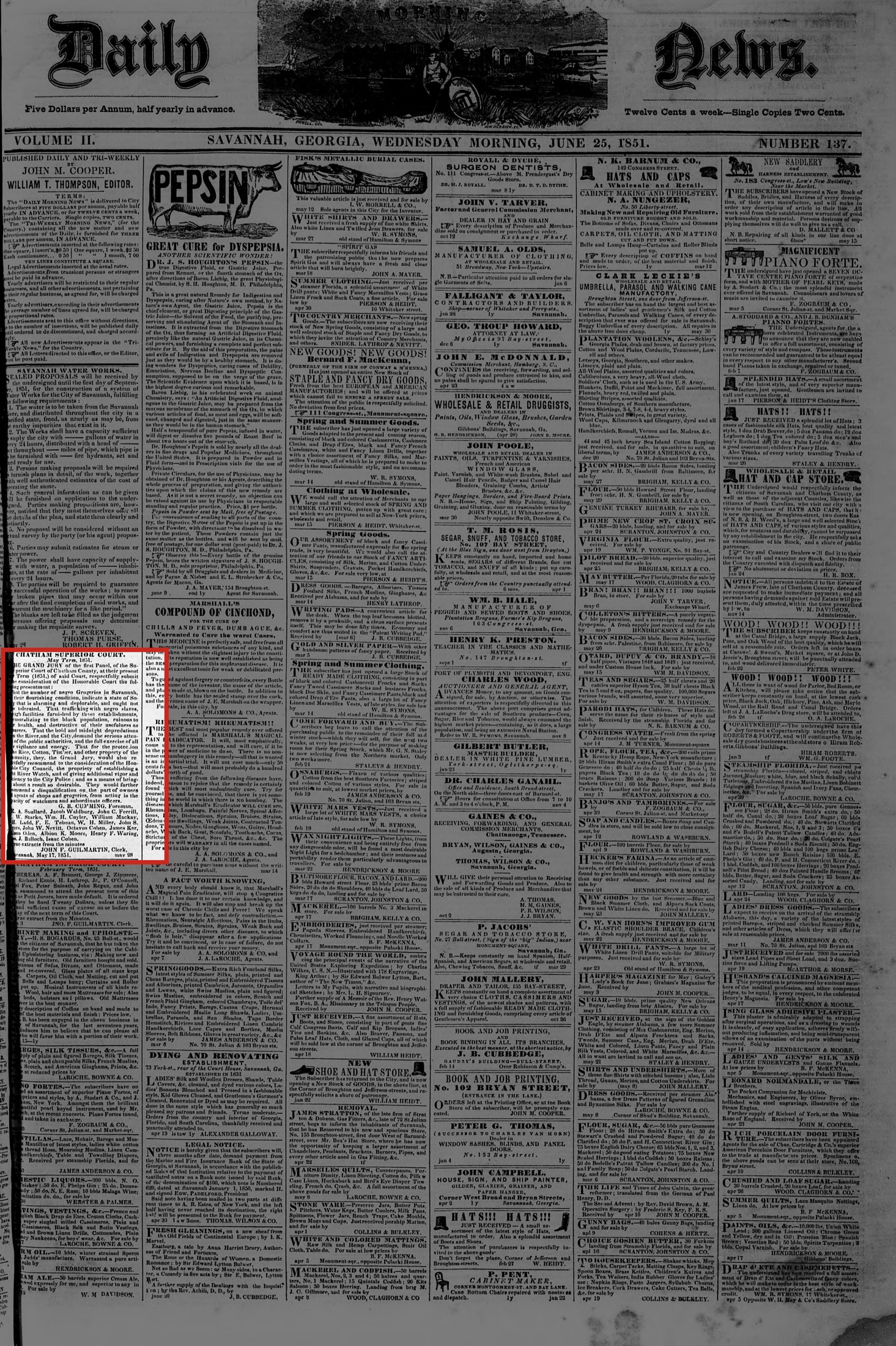
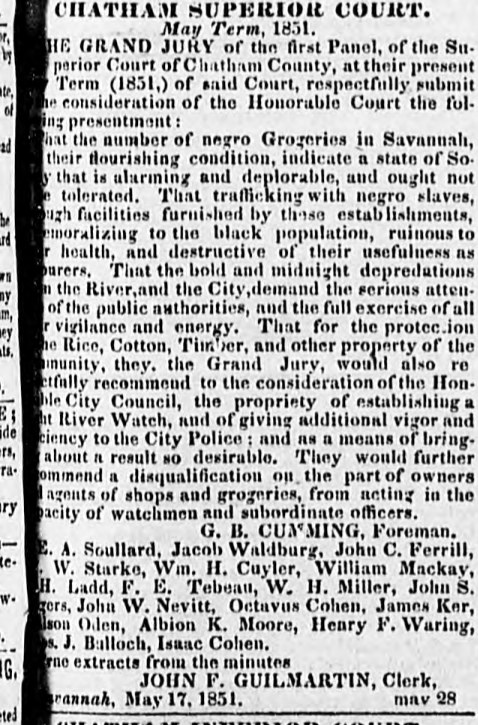
The whole presentment, as printed. The left edge sits in the page’s binding shadow, so the first letters of some lines are lost in the scan itself.
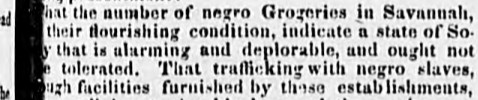
Two clippings from the same notice.
“…the number of negro Grogeries in Savannah, and their flourishing condition, indicate a state of Society that is alarming and deplorable…”
“…a disqualification on the part of owners and agents of shops and grogeries, from acting in the capacity of watchmen and subordinate officers.”

Transcribed from the page and checked word by word. Letters in [brackets] are lost in the binding shadow and restored from context; […] marks letters that cannot be read. One note: the archive’s search text reads “Groceries.” The printed page says “Grogeries.”
CHATHAM SUPERIOR COURT.
May Term, 1851.
[T]HE GRAND JURY of the first Panel, of the Superior Court of Chatham County, at their present [May] Term (1851,) of said Court, respectfully submit [to th]e consideration of the Honorable Court the fol[low]ing presentment:
[T]hat the number of negro Grogeries in Savannah, [and] their flourishing condition, indicate a state of So[ciet]y that is alarming and deplorable, and ought not [to b]e tolerated. That trafficking with negro slaves, [thro]ugh facilities furnished by these establishments, [is d]emoralizing to the black population, ruinous to [thei]r health, and destructive of their usefulness as [lab]ourers. That the bold and midnight depredations [o]n the River, and the City, demand the serious atten[tion] of the public authorities, and the full exercise of all [thei]r vigilance and energy. That for the protection [of th]e Rice, Cotton, Timber, and other property of the [com]munity, they, the Grand Jury, would also re[spe]ctfully recommend to the consideration of the Hon[ora]ble City Council, the propriety of establishing a [nigh]t River Watch, and of giving additional vigor and [effi]ciency to the City Police: and as a means of bring[ing] about a result so desirable. They would further [rec]ommend a disqualification on the part of owners [and] agents of shops and grogeries, from acting in the [ca]pacity of watchmen and subordinate officers.
G. B. CUMMING, Foreman.
[…]E. A. Soullard, Jacob Waldburg, John C. Ferrill, […] W. Starke, Wm. H. Cuyler, William Mackay, […] H. Ladd, F. E. Tebeau, W. H. Miller, John S. […]gers, John W. Nevitt, Octavus Cohen, James Ker, […]son Oden, Albion K. Moore, Henry F. Waring, […]s. J. Bulloch, Isaac Cohen.
[A t]rue extracts from the minutes
JOHN F. GUILMARTIN, Clerk.
[S]avannah, May 17, 1851. may 28
Walk Savannah’s riverfront and market streets on Hidden in Plain Sight: An Incomplete Freedom, a free self-guided tour.
Go to [MATCHING STOP] →“Chatham Superior Court. May Term, 1851.” Grand jury presentment, signed May 17, 1851. Daily Morning News (Savannah, GA), June 25, 1851, p. 1. Georgia Historic Newspapers, Digital Library of Georgia.
Black history and life as seen through Savannah’s newspapers, 1763–1965
{{yearsAgo}} {{stampText}}.
Negroes and alcohol
{{nowText}}
In May 1851, the grand jury of Chatham County’s Superior Court made a formal presentment, a public list of problems it wanted addressed. Its first item was “the number of negro Grogeries in Savannah, and their flourishing condition.” A grogery, or grog shop, sold liquor.
The jurors wrote that the shops gave “facilities” for “trafficking with negro slaves,” and they also cited “bold and midnight depredations” on the river and in the city. They asked City Council for a River Watch and a stronger City Police.
Their last request: that owners and agents of shops and grogeries be barred from serving as the city’s watchmen and subordinate officers. The notice was signed May 17, 1851, and the Daily Morning News kept printing it for weeks, including on the front page of June 25.
The whole presentment, as printed. The left edge sits in the page’s binding shadow, so the first letters of some lines are lost in the scan itself.
Two clippings from the same notice.
“…the number of negro Grogeries in Savannah, and their flourishing condition, indicate a state of Society that is alarming and deplorable…”
“…a disqualification on the part of owners and agents of shops and grogeries, from acting in the capacity of watchmen and subordinate officers.”
Transcribed from the page and checked word by word. Letters in [brackets] are lost in the binding shadow and restored from context; […] marks letters that cannot be read. One note: the archive’s search text reads “Groceries.” The printed page says “Grogeries.”
CHATHAM SUPERIOR COURT.
May Term, 1851.
[T]HE GRAND JURY of the first Panel, of the Superior Court of Chatham County, at their present [May] Term (1851,) of said Court, respectfully submit [to th]e consideration of the Honorable Court the fol[low]ing presentment:
[T]hat the number of negro Grogeries in Savannah, [and] their flourishing condition, indicate a state of So[ciet]y that is alarming and deplorable, and ought not [to b]e tolerated. That trafficking with negro slaves, [thro]ugh facilities furnished by these establishments, [is d]emoralizing to the black population, ruinous to [thei]r health, and destructive of their usefulness as [lab]ourers. That the bold and midnight depredations [o]n the River, and the City, demand the serious atten[tion] of the public authorities, and the full exercise of all [thei]r vigilance and energy. That for the protection [of th]e Rice, Cotton, Timber, and other property of the [com]munity, they, the Grand Jury, would also re[spe]ctfully recommend to the consideration of the Hon[ora]ble City Council, the propriety of establishing a [nigh]t River Watch, and of giving additional vigor and [effi]ciency to the City Police: and as a means of bring[ing] about a result so desirable. They would further [rec]ommend a disqualification on the part of owners [and] agents of shops and grogeries, from acting in the [ca]pacity of watchmen and subordinate officers.
G. B. CUMMING, Foreman.
[…]E. A. Soullard, Jacob Waldburg, John C. Ferrill, […] W. Starke, Wm. H. Cuyler, William Mackay, […] H. Ladd, F. E. Tebeau, W. H. Miller, John S. […]gers, John W. Nevitt, Octavus Cohen, James Ker, […]son Oden, Albion K. Moore, Henry F. Waring, […]s. J. Bulloch, Isaac Cohen.
[A t]rue extracts from the minutes
JOHN F. GUILMARTIN, Clerk.
[S]avannah, May 17, 1851. may 28
Walk Savannah’s riverfront and market streets on Hidden in Plain Sight: An Incomplete Freedom, a free self-guided tour.
Go to [MATCHING STOP] →“Chatham Superior Court. May Term, 1851.” Grand jury presentment, signed May 17, 1851. Daily Morning News (Savannah, GA), June 25, 1851, p. 1. Georgia Historic Newspapers, Digital Library of Georgia.